
Low Water Response
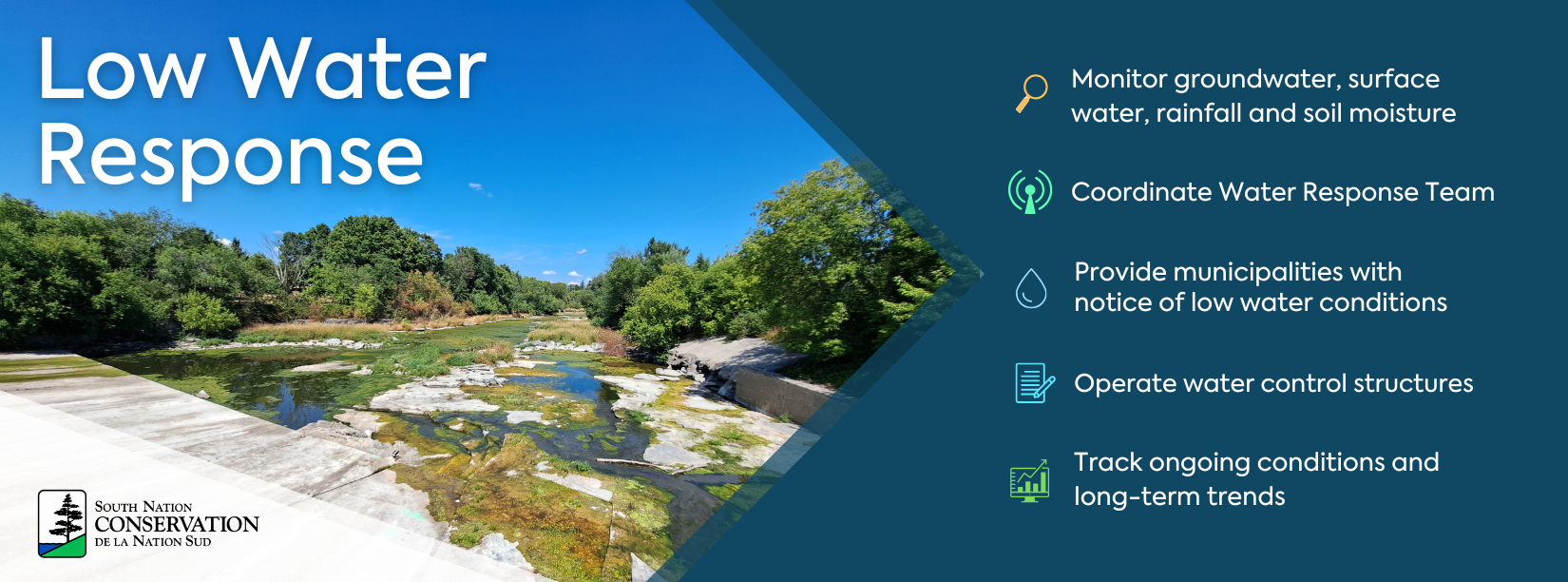
Low rainfall and hot temperatures in the summer can result in low streamflows and low groundwater levels. This can have an impact on the amount of water available for human use and agriculture operations, as well as the amount of water available to ensure a healthy aquatic habitat.
When this happens, a Low Water Response plan can be put into effect to provide guidance to major water users on ways they can reduce their water consumption.
The Ontario government developed a Low Water Response Plan in 2000 to assist in coordination and to support local response in the event of a drought. Under this program, Conservation Authorities have each formed a Water Response Team to ensure that the public is provided with advance warning of reduced water availability, and that related decisions are made by local stakeholders.
South Nation Conservation’s Water Response Team is made up of representatives of water users: member municipalities, farmers, businesses, recreation and others. The Low Water Response Team meets as required during the summer to review stream flow information and weather forecasts. Based on the information, the committee may declare a low water condition for each part of the SNC watershed.
What do low water levels mean?

Level Normal: Water supply problem is not of concern.

Level 1: Flows are less than 70 per cent of their normal summer low flow. Water users are asked to voluntarily reduce their consumption by 10 per cent.

Level 2: Flows are less than 50 per cent of their normal summer low flow. The Ministry of the Environment will send letters to holders of Permits to Take Water to ask them to voluntarily reduce their consumption by 20 per cent.

Level 3: Flows are less than 30 per cent of their normal summer low flow and there is potential for economic harm to water takers and/or significant harm to the ecosystem. The Water Response Team may ask the province to impose mandatory restrictions on those holding Permits to Take Water.
Municipal water use bylaws
In addition to the provincial Low Water Response Plan, municipalities have passed their own water use bylaws which include restrictions on lawn watering, car washing and other outdoor water use.